
2024 Beyond the Sky’s Limits 4, Journeys

It’s easier to invent the future than to predict it. ― Alan Kay * How high is the sky? On August 16, 1960, Joe Kittinger rode a balloon to the edge of Earth’s atmosphere. Up there, where the temperature is -94 degrees Fahrenheit yet blood would boil, he stepped off the platform and plunged 102,800 feet, twice as high as jetliners flew. His speed: 614 miles per hour, approached the sound barrier. Earth’s atmosphere extends 6,200 miles above the planet. After that, the atmosphere blends into space. In jumping from over 19 miles above the Earth, Kittinger reached beyond the sky’s limits. Fifty-two years later, he helped Felix Baumgartner repeat that experience. Watch Joe Kittinger’s jump [3 minutes]. The theme for this fourth of four “Beyond the Sky’s Limits” posts is, “Travel.” Photographs from my “SkyScapes Gallery” accompany this series. Here are five favorite quotes, All journeys have secret destinations of which the traveler is unaware. — Martin Buber It is good to have an end to journey toward; but it is the journey that matters, in the end. — Ursula K. LeGuin A journey is best measured in friends, rather than miles. – Tim Cahill Not all those who wander are lost. — J.R.R. Tolkien We too can be pioneers. Not by opening up vast new geographic frontiers, but rather, by finding more thoughtful ways to approach those already discovered. — Sven-Olaf Lindblad Succeed and Soar! SkyScapes Pouches Organize travels and carry possessions safe and secure in these unique and beautiful wallets. Details: Three sizes: Small 6” x 4” , Medium 9.5” x 6” and Large 12.5” x 8.5” Crafted with 100% poly-poplin fabric Double-stitched at seams for extra durability Durable metal zipper Visit All Zippered Pouches Thanks for shopping!
Horseshoe Curve
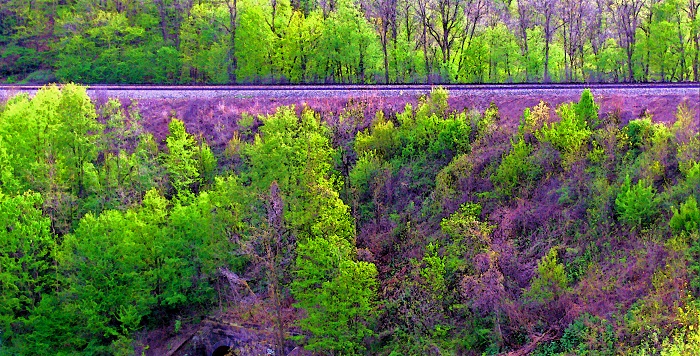
There is only one map to the journey of life and it lives within your heart. — Willie Nelson Horseshoe Curve is the engineering feat that filled in two river valleys and scraped away mountain sides so that travel was quicker and less hazardous as America expanded westward. When trains could finally cross the Allegheny Mountains, they replaced the slow canal boats and the dangerous ways a portage railroad hauled them over the mountains. Otherwise, people traveled forest trails by foot, horse and oxcart. The Horseshoe was gouged out of the mountainsides and the river valleys were filled by laborers [mainly European immigrants] who used crude wheelbarrows and shovels, sledges and picks. The railroad opened on February 15, 1854. Passenger travel around the 2,375-foot-long, 1,300-foot-wide Horseshoe peaked in the 1940s, with over fifty trains a day carrying people around that 220-degree curve, which Hitler targeted as part of the Nazi plan to cripple the United States [Operation Pastorius]. Today, one silvery passenger train rounds the Horseshoe Curve, Amtrak’s eastbound Pennsylvania #42 approaches near ten in the morning. The westbound Pennsylvania #43 returns eight hours later. Upon approach, conductors announce the Curve. Some speak of its history and the construction. They tell riders which side of the train will face the Horseshoe so that passengers in the back can see those ahead and those in front can see where they’ve been, as well as people at the National Historic Landmark waving and applauding the travelers’ journeys, where some may experience what Lillian Smith understood, I soon realized that no journey carries one far unless, as it extends into the world around us, it goes an equal distance into the world within.